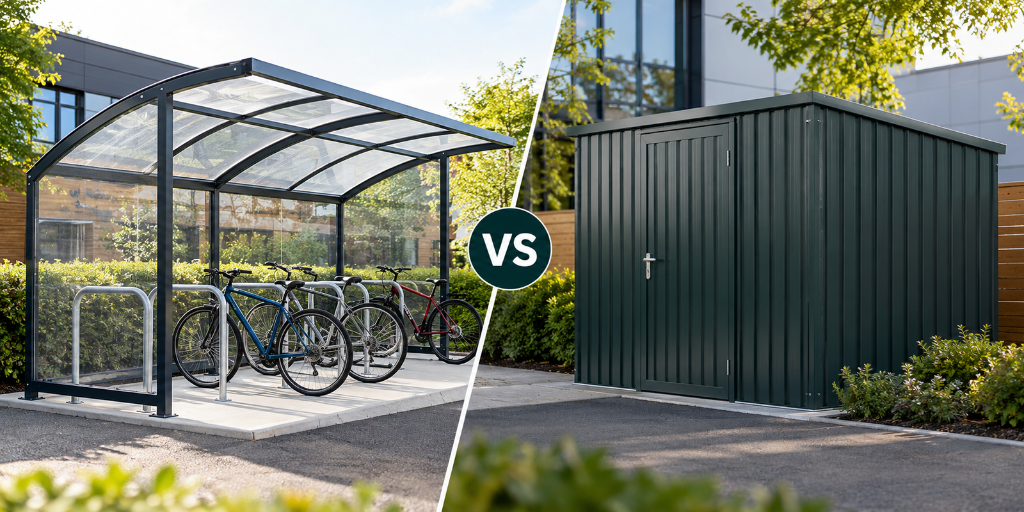
When employees, students or visitors cycle to your premises, they need somewhere safe to leave their bicycles. A covered parking area provides protection from the weather, but how much protection does a commercial cycle shelter actually offer against theft?
The answer depends on its construction, locking facilities, location and accessibility.
An open cycle shelter with secure stands may be suitable for a supervised school or workplace. However, organisations where bicycles are left unattended for long periods may benefit from a lockable cycle compound.
Understanding these differences can help facilities managers choose cycle storage that balances security, convenience and everyday practicality.
How Secure Are Commercial Cycle Shelters?
Commercial cycle shelters can provide effective bicycle security when they combine secure locking points, robust construction, appropriate installation and good site positioning. Enclosed cycle compounds offer additional protection by restricting access to the storage area.
However, no cycle shelter can guarantee complete protection against theft.
The Department for Transport’s Cycle Infrastructure Design guidance (LTN 1/20) provides guidance on cycle parking, including security, accessibility and suitability for different users.
The appropriate level of protection depends on the site’s theft risk, the value of bicycles being stored and how long they remain unattended.
Seven Features That Make Commercial Cycle Shelters More Secure
1. Secure Sheffield Stands and Locking Points
A secure cycle shelter needs suitable facilities for locking individual bicycles.
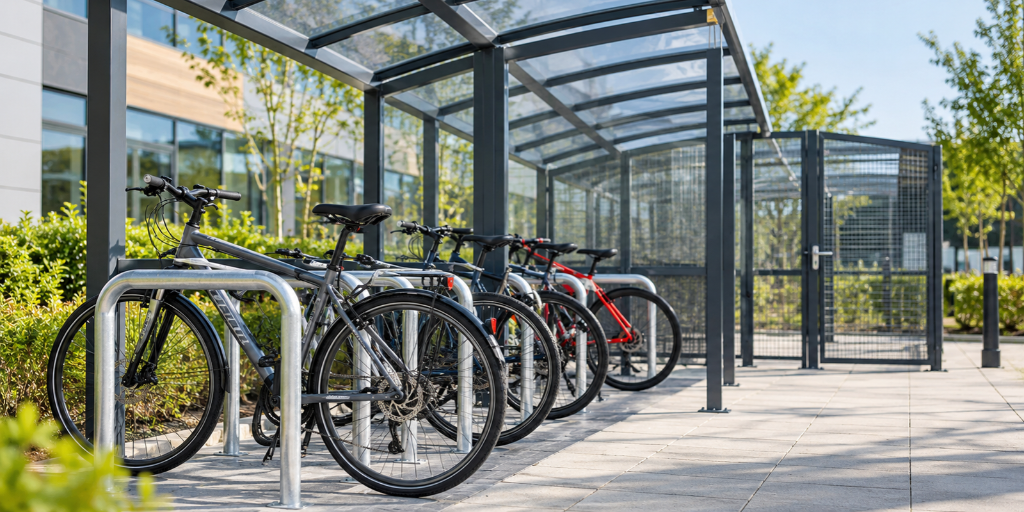
Sheffield stands are commonly used in commercial cycle parking because their inverted U-shaped design supports bicycles and allows the frame and wheels to be secured to a fixed structure.
Unlike many wheel-only racks, they provide practical locking points without relying solely on the bicycle’s wheel for support.
The stands themselves must also be firmly anchored to suitable foundations.
2. Robust Framework and Ground Anchoring
A commercial cycle shelter should be designed and installed to suit its intended location and ground conditions.
Steel frameworks can provide a durable structure, but security also depends on connections, fixings and foundations.
A substantial shelter may still present vulnerabilities if it is inadequately anchored or poorly maintained.
Additional measures, such as tamper-resistant fixings, may be worth considering for higher-risk locations. However, their availability and compatibility should be confirmed with the supplier rather than assumed to be standard.
3. Lockable Gates and Controlled Access
Lockable cycle compounds provide an additional physical barrier by restricting access to the storage area.
Depending on the product, access may be controlled through keys or other locking arrangements.
This can be particularly useful for workplaces where bicycles remain unattended throughout the working day.
However, controlled access does not eliminate the need for individual bicycle locks.
4. Appropriate Lighting and Visibility
A well-constructed shelter may still be vulnerable when positioned in an isolated or poorly illuminated area.
Ideally, cycle parking should be visible from occupied buildings, entrances or regularly used pedestrian routes.
Suitable lighting also makes facilities easier to use during darker mornings and evenings.
Active Travel England provides guidance on planning cycle parking, including accessibility and site considerations.
5. Secure Enclosure Panels and Gates
For enclosed compounds, gates, panels, hinges and locking mechanisms all contribute to the overall security arrangement.
Facilities managers should consider the construction and condition of these components rather than assuming that an enclosed structure is automatically theft-resistant.
Weather-resistant glazing and strong framework materials can be useful, but they should not be confused with independently certified anti-theft protection.
6. CCTV and Additional Site Security
CCTV can support bicycle security by monitoring activity and helping organisations review incidents.
It may be particularly useful for larger workplaces, campuses and public facilities.
However, cameras cannot physically prevent someone from removing an inadequately secured bicycle.
CCTV should therefore complement suitable locking facilities, controlled access and good site positioning.
7. Regular Maintenance and Inspections
Even well-designed cycle storage requires periodic inspection.
Loose stands, damaged gates, defective locks and deteriorating fixings can reduce security over time.
Facilities teams should check that stands remain securely anchored, access controls function correctly, and structural components remain in suitable condition.
Identified defects should be assessed and addressed promptly.
Understanding Sold Secure and Secured by Design
When comparing secure bicycle storage, it is useful to understand two recognised UK security schemes.
Sold Secure independently tests security products, including bicycle locks, against attempted attacks. Its pedal-cycle ratings range from Bronze to Diamond, with Diamond offering the highest level of tested resistance.
Secured by Design is the official police security initiative that promotes crime prevention through product standards and the design of safer environments. Its Police Preferred Specification identifies security products that meet recognised requirements.
These schemes can help organisations and cyclists make informed security decisions. However, a Sold Secure-rated bicycle lock does not mean that the entire cycle shelter is independently certified.
Facilities managers should check whether any claimed certification applies to the individual lock, access system or complete storage structure.
Further information is available from Sold Secure and Secured by Design.
Open Cycle Shelters vs Lockable Cycle Compounds
Both options provide covered bicycle parking, but they differ in security, access arrangements and maintenance requirements.
Access: Open cycle shelters generally allow unrestricted access, while lockable compounds restrict entry through lockable gates.
Theft protection: Open shelters rely heavily on individual bicycle locks, secure stands and site positioning. Lockable compounds provide an additional physical barrier.
Everyday use: Open shelters offer quick and convenient access. Compounds require users to manage keys or other access arrangements.
Installation: Open shelters may be simpler to install, while enclosed compounds can require additional groundwork and gate installation.
Maintenance: Both require inspection of the framework, roof and stands. Compounds also require maintenance of gates, hinges and locking mechanisms.
Suitable applications: Open shelters may be appropriate for visitor parking and supervised locations. Lockable compounds may be more suitable for long-stay staff parking and higher-risk sites.
A supervised school may find an open shelter appropriate, while a workplace where expensive bicycles remain unattended for several hours may benefit from a lockable compound.
The decision should reflect actual security risks rather than simply choosing the most enclosed structure.
How Can Facilities Managers Assess Existing Cycle Shelter Security?
Before investing in new storage, organisations should review the security of their existing facilities.
A practical assessment should consider:
- Theft risk: Have bicycles previously been stolen or damaged on-site?
- Bicycle value and storage duration: Are expensive bicycles or e-bikes left unattended for extended periods?
- Locking facilities: Are stands securely anchored, and can users lock frames and wheels properly?
- Visibility and access: Is the parking area well-lit, overlooked and appropriately accessible?
- Physical condition: Are the framework, fixings, gates and locking mechanisms in good condition?
These checks can help identify whether improvements are required.
In some cases, repairing damaged components or improving lighting may be sufficient. Where the existing structure cannot meet the required security level, upgrading to a different storage design may be more appropriate.
For additional advice, see Tamstar’s guide to choosing the best location for a cycle shelter.
Choosing Secure Commercial Cycle Storage with Tamstar
At Tamstar, we understand that cycle storage must balance security, capacity, convenience and the practical requirements of each site.
Our range of commercial cycle shelters and bike storage solutions includes options for workplaces, schools and larger organisations.
For locations requiring restricted access, our Omega Lockable Cycle Compound features a galvanised steel framework, 4 mm clear PETG roof and side glazing, lockable side-access gates and included cycle stands. Its modular design accommodates configurations from 20 to more than 100 bicycles, with on-site installation available.
These are product features, not a claim of independent anti-theft certification. Additional security requirements, including specialist locking systems or tamper-resistant fixings, should be discussed and their availability confirmed before ordering.
Frequently Asked Questions
Can bicycles still be stolen from commercial cycle shelters?
Yes. No shelter is completely theft-proof. Properly secured stands, suitable bicycle locks, good visibility and controlled access can help reduce the risk.
Are lockable cycle compounds more secure than open shelters?
A lockable compound adds a physical barrier by restricting entry. However, its effectiveness depends on the enclosure, gates, locks and installation.
Are Sheffield stands suitable for secure bicycle parking?
Yes. Properly installed Sheffield stands provide practical locking points for bicycle frames and wheels. Users should still choose appropriate bicycle locks.
Do commercial cycle shelters need CCTV?
Not necessarily. CCTV can support security at higher-risk locations, but it should complement physical protection rather than replace it.
Can existing cycle shelters be upgraded?
Potentially. Depending on their condition and design, improvements may include replacement stands, lighting, repairs or additional access controls.
Are commercial cycle shelters suitable for electric bikes?
Yes, provided the layout accommodates their dimensions and weight. High-security locks are particularly important for valuable e-bikes.
Conclusion: Choosing the Right Security for Your Cycle Storage
Commercial cycle shelters can help protect bicycles, but effective security depends on the complete installation.
Suitable stands, robust construction, secure anchoring and thoughtful positioning all contribute to a safer storage environment. Where additional protection is needed, lockable cycle compounds can provide another layer of security.
Whether you’re planning cycle storage for a new development or reviewing an existing facility, choosing the right solution starts with understanding your site’s requirements.
Tamstar can help you compare commercial cycle shelters and lockable compounds based on capacity, available space and practical security considerations.
Explore our cycle shelters and bike storage range to find a suitable solution for your workplace, school or commercial premises.