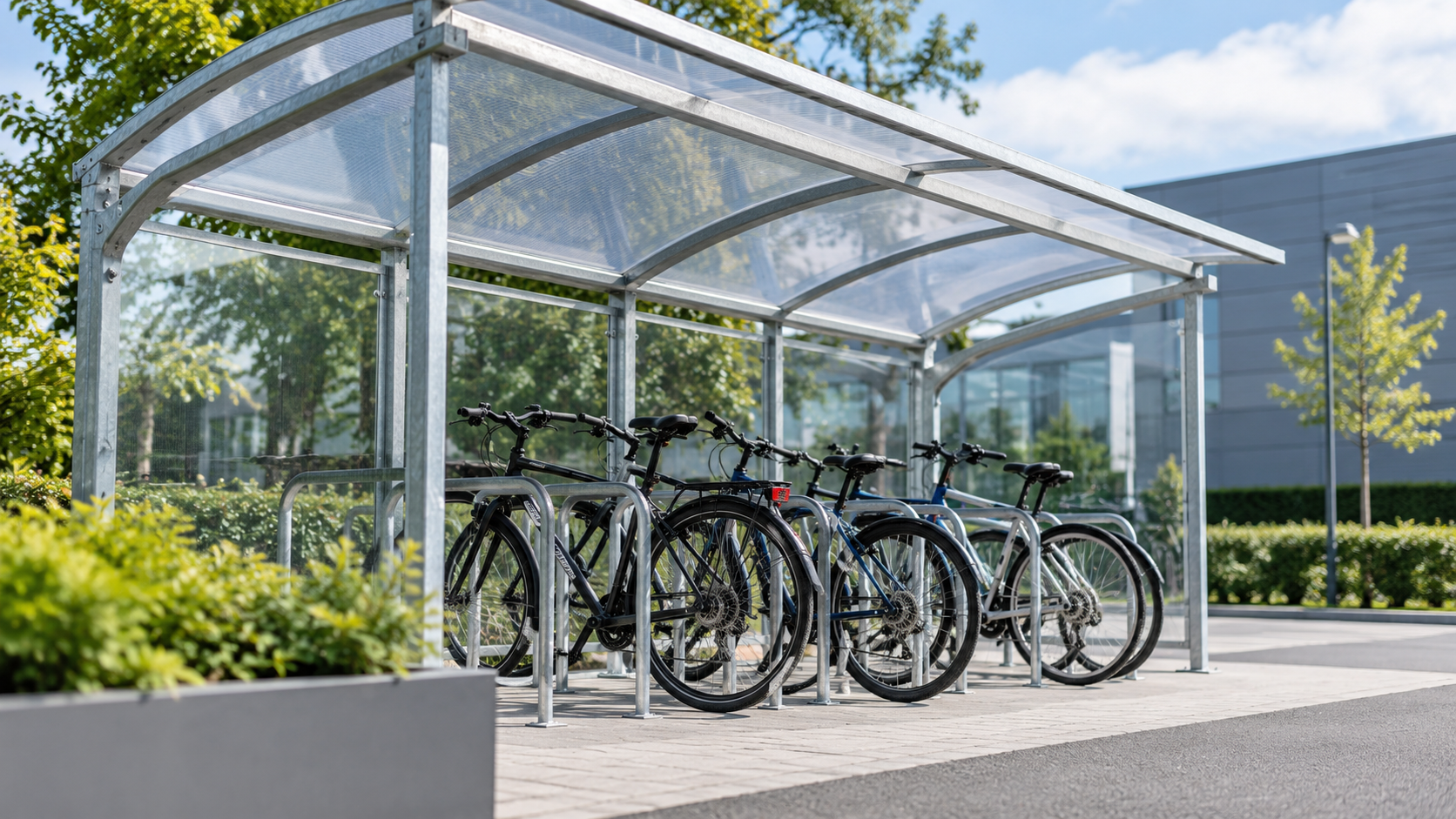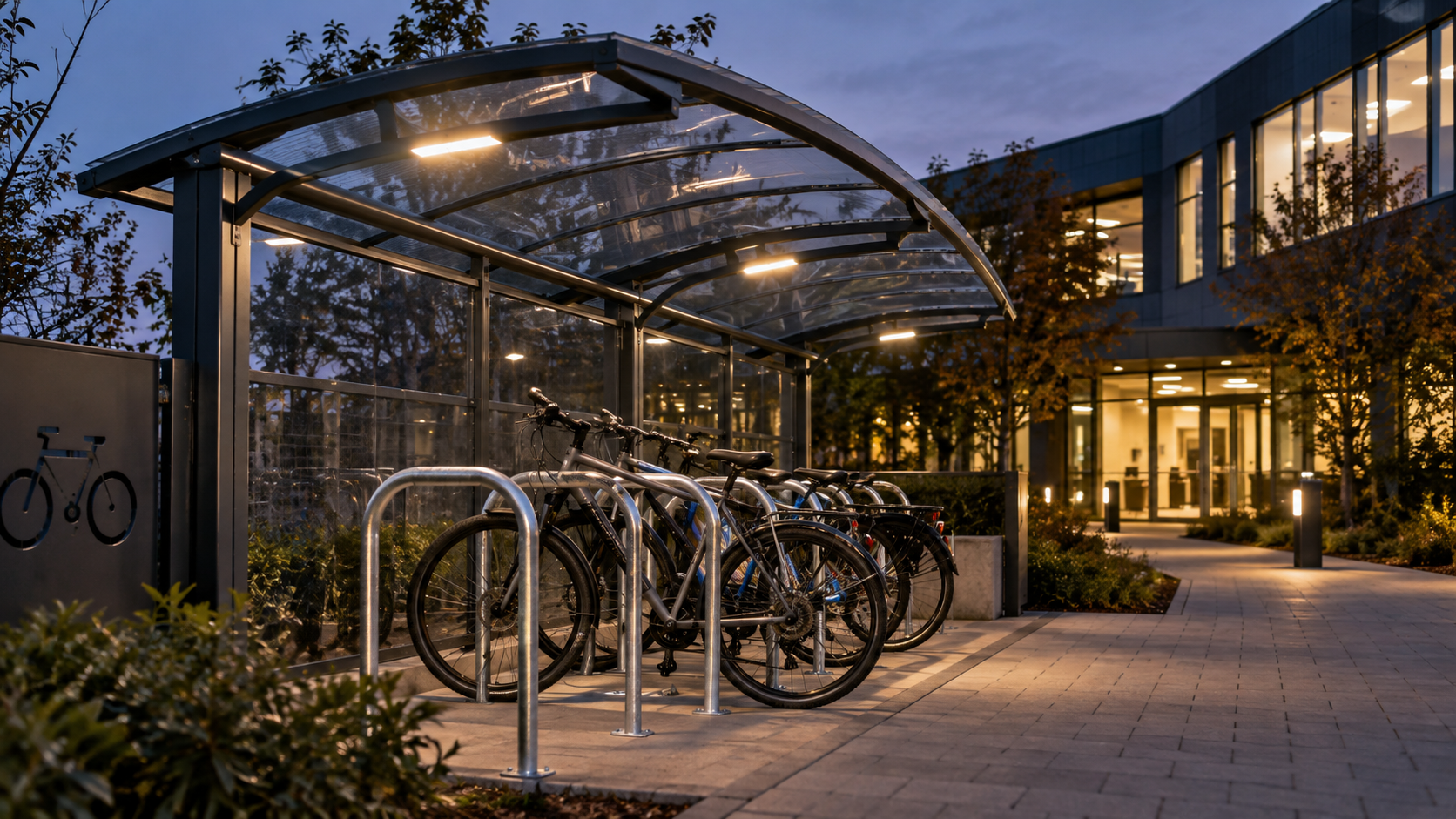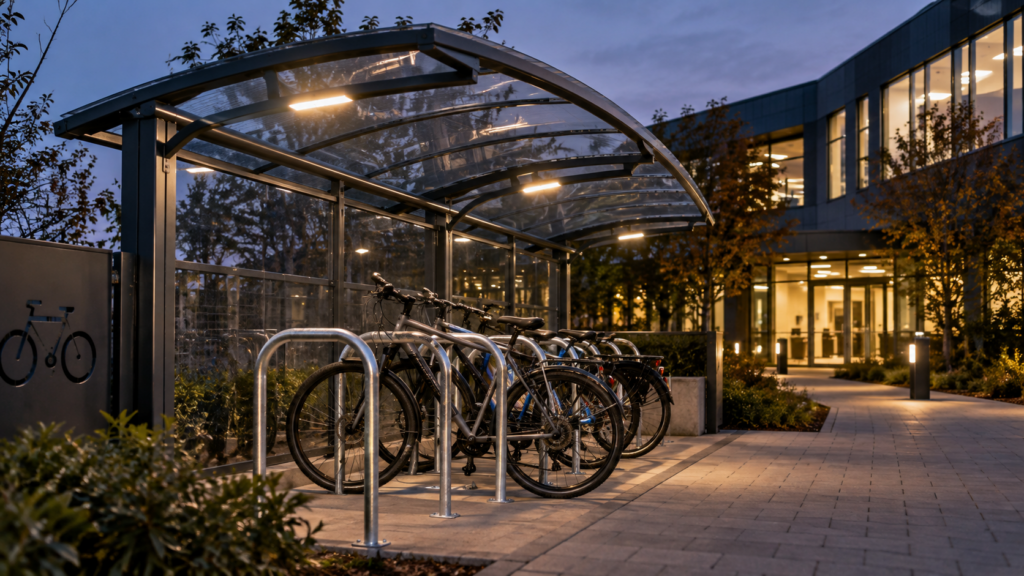
A cycle shelter that works perfectly well at 4pm in July can feel very different at 5pm in November.
As daylight hours shorten across the UK, weaknesses in cycle storage can become more noticeable. Poor lighting, limited visibility, isolated locations, inadequate locking points and awkward routes to and from a cycle shelter can all affect how secure and practical the facility feels.
For facilities managers, estates teams, schools and businesses, autumn is therefore a good time to ask a more useful question than simply: “Do we provide cycle parking?”
The better question is: “Is our cycle storage secure, visible and practical when people are arriving and leaving in the dark?”
Why is secure cycle storage more important during darker months?
Secure cycle storage matters throughout the year, but shorter daylight hours mean more employees, students and visitors may access cycle parking in darkness or low light.
Department for Transport guidance states that cycle parking, and routes to and from it, should be clearly marked, overlooked, well maintained, well lit and integrated into the built environment. For longer-stay cycle parking, such as at workplaces and educational buildings, security is a primary consideration.
Good cycle storage therefore needs to do more than keep bicycles out of the rain. Location, visibility, lighting, locking facilities, access and the level of security required should all be considered together.
1. Start with where your cycle storage is located
One of the most important security decisions happens before a cycle shelter or rack is chosen: where will it go?
An unused corner of a car park might appear convenient, but if it is hidden behind a building, poorly overlooked or a long walk from the entrance, it may not be the best location.
Cycle parking positioned near entrances, windows, reception areas or other regularly occupied parts of a site can benefit from greater natural surveillance.
Active Travel England advises that cycle parking should be secure, overlooked, well maintained and well lit.
Consider the journey as well as the destination. Can cyclists reach the storage area conveniently? Is the route between the shelter and building clear? Does it remain visible and accessible after dark?
The best location is not necessarily the space that is easiest to spare.
2. A cycle shelter and secure cycle storage are not always the same thing
This is an important distinction.
A cycle shelter provides a designated, covered area for bicycles and, combined with suitable cycle stands or racks, can provide a practical solution for many workplaces, schools and commercial sites.
Some sites, however, require greater access control.
A lockable cycle compound adds an enclosed area around the bicycles themselves. This may be worth considering where bikes are left for long periods, public access to the site is relatively open or greater control over who can enter the storage area is required.
There is no single solution for every organisation. The appropriate level of security depends on where bicycles are stored, how long they are left, who can access the area and how the site operates.
3. Give cyclists a suitable way to secure their bikes
Shelter from the weather is useful, but cyclists also need an appropriate point to which they can lock their bicycle.
Sheffield-style cycle stands are widely used because they support the bicycle while providing a practical locking point.
Tamstar’s Sheffield toast rack systems, for example, are available in different capacities and can be fixed to a suitable existing concrete surface. Their design allows the bicycle’s frame and wheel to be secured to the rack using the cyclist’s own lock.
For facilities managers, it helps to consider the complete arrangement:
Shelter + stands + locking opportunity + location + access.
A good shelter in a poor location with inadequate locking provision does not solve the whole security problem.
4. Look at lighting, visibility and natural surveillance
If you normally inspect your cycle parking during the working day, consider how it feels to someone leaving the building after dark.
Can they clearly see the storage area and the route towards it? Can the cycle parking be seen from occupied areas? Are bushes, walls, bins, parked vehicles or other obstructions creating hidden areas or poor sightlines?
Lighting and natural surveillance are separate but complementary considerations. Lighting improves visibility, while positioning cycle parking where it is naturally overlooked can reduce isolation.
Where CCTV already forms part of a site’s security arrangements, its coverage may also be relevant when reviewing cycle-storage locations.
The objective is to consider the whole journey between the building, cycle parking and site exit, rather than looking at the shelter in isolation.
5. Does your site need controlled-access cycle storage?
An open cycle shelter with suitable stands may be appropriate in a well-overlooked location on a controlled site. Elsewhere, an enclosed and lockable compound may provide a more suitable solution.
Tamstar’s Omega Cycle Shelter Compound, for example, provides enclosed cycle storage with lockable gate access and cycle stands, offering an option for organisations requiring a more controlled storage arrangement.
The key is not automatically choosing the most enclosed solution.
Instead ask: What level of security does this particular site and its users actually require?
That leads to a better purchasing decision than selecting a shelter based only on appearance or capacity.
6. Check whether existing cycle storage is still fit for purpose
Autumn is also a useful time to inspect an existing cycle shelter.
Check the condition of the frame, fixings, roof and panels, cycle stands, gates, surrounding ground and access routes. Look for loose or damaged components, damaged or missing glazing, corrosion, unstable stands, obstructed access or vegetation reducing visibility.
Finding deterioration does not automatically mean replacing the entire shelter.
If the main structure remains suitable, targeted repair or refurbishment may be worth assessing. Where there is significant structural deterioration, inadequate capacity, unsuitable access or a design that no longer meets the site’s requirements, upgrading or replacement may make more sense.
A sensible approach is:
Assess → retain what remains serviceable → repair or refurbish where appropriate → replace or upgrade where necessary.
7. Don’t forget capacity and accessibility
A secure cycle facility still needs to be practical.
If a shelter is routinely full, cyclists may start attaching bikes to fences, railings or other structures outside the designated parking area.
Capacity should therefore reflect real usage and likely future demand. Different cycles may also require different amounts of space, including larger, adapted or cargo cycles.
Access matters too. Users need enough room to manoeuvre bicycles safely, and cycle parking should not unnecessarily obstruct pedestrian routes.
If demand has changed since your shelter was installed, autumn is a good opportunity to check whether the existing capacity still works.
A simple 7-point cycle storage security check
Walk through your cycle facility as a cyclist would and check these seven areas:
1. Location: Is the storage conveniently positioned rather than hidden in an isolated part of the site?
2. Visibility: Is it overlooked, with clear sightlines around the facility?
3. Lighting: Can users see the parking area and route to it during darker mornings and evenings?
4. Locking: Can bicycles be secured appropriately to suitable stands or racks?
5. Access: Can cyclists enter and leave conveniently without unnecessary conflicts with pedestrians or vehicles?
6. Condition: Are the shelter, panels, stands, gates, fixings and surrounding surfaces in suitable condition?
7. Capacity: Is there enough usable storage for current demand and the types of cycles being used?
If one or more areas are weak, you have a clear starting point for deciding what needs attention.
Choosing the right cycle storage solution
The right solution depends on the site.
Some organisations may simply need additional Sheffield cycle stands. Others may benefit from a covered cycle shelter, while sites requiring greater access control may be better suited to a lockable cycle compound.
For example, Tamstar’s Astro Cycle Shelter provides covered storage for 10 cycles and includes a rack system. Other options are available for different capacities and security requirements.
Before ordering, consider:
How many cycles need storing? Where will the facility be positioned? How long are bicycles normally left there? What level of security is appropriate? Is the location accessible and visible? Could demand increase in future?
Answering these questions first makes choosing an appropriate solution much easier.
Frequently Asked Questions
What makes cycle storage secure?
Secure cycle storage combines suitable locking points with good location, visibility, lighting and convenient access. Depending on the site, controlled access, a lockable compound or existing CCTV coverage may also be appropriate.
Should cycle parking be well lit?
Yes. Department for Transport guidance states that cycle parking and routes to and from it should be well lit, overlooked and well maintained.
Is a cycle shelter the same as a lockable cycle compound?
No. A cycle shelter provides covered parking, usually combined with stands or racks. A cycle compound provides an enclosed area with controlled or lockable access where greater security is required.
Where should workplace cycle storage be positioned?
Cycle storage should be convenient, accessible and appropriately secure. Visibility, natural surveillance and the route between the parking area and building should all be considered.
Does an old cycle shelter need replacing?
Not necessarily. If the main structure remains suitable, individual components may be repairable or replaceable. Assess its condition, capacity and suitability before deciding whether to repair, refurbish or replace it.
Review your cycle storage before the darker months arrive
Secure cycle storage is about more than putting a roof over a row of bicycles.
As daylight hours shorten, location, visibility, lighting, locking points, access, capacity and condition become increasingly important.
A simple site review can reveal whether your existing storage remains suitable or whether additional stands, repairs, a new shelter or a more secure compound should be considered.
Tamstar supplies cycle shelters, Sheffield cycle stands, bike racks and lockable cycle compounds for schools, workplaces and commercial sites across the UK.
If you’re planning new cycle storage or reviewing an existing facility, explore Tamstar’s cycle-storage range or speak to the team about your site, capacity and security requirements.