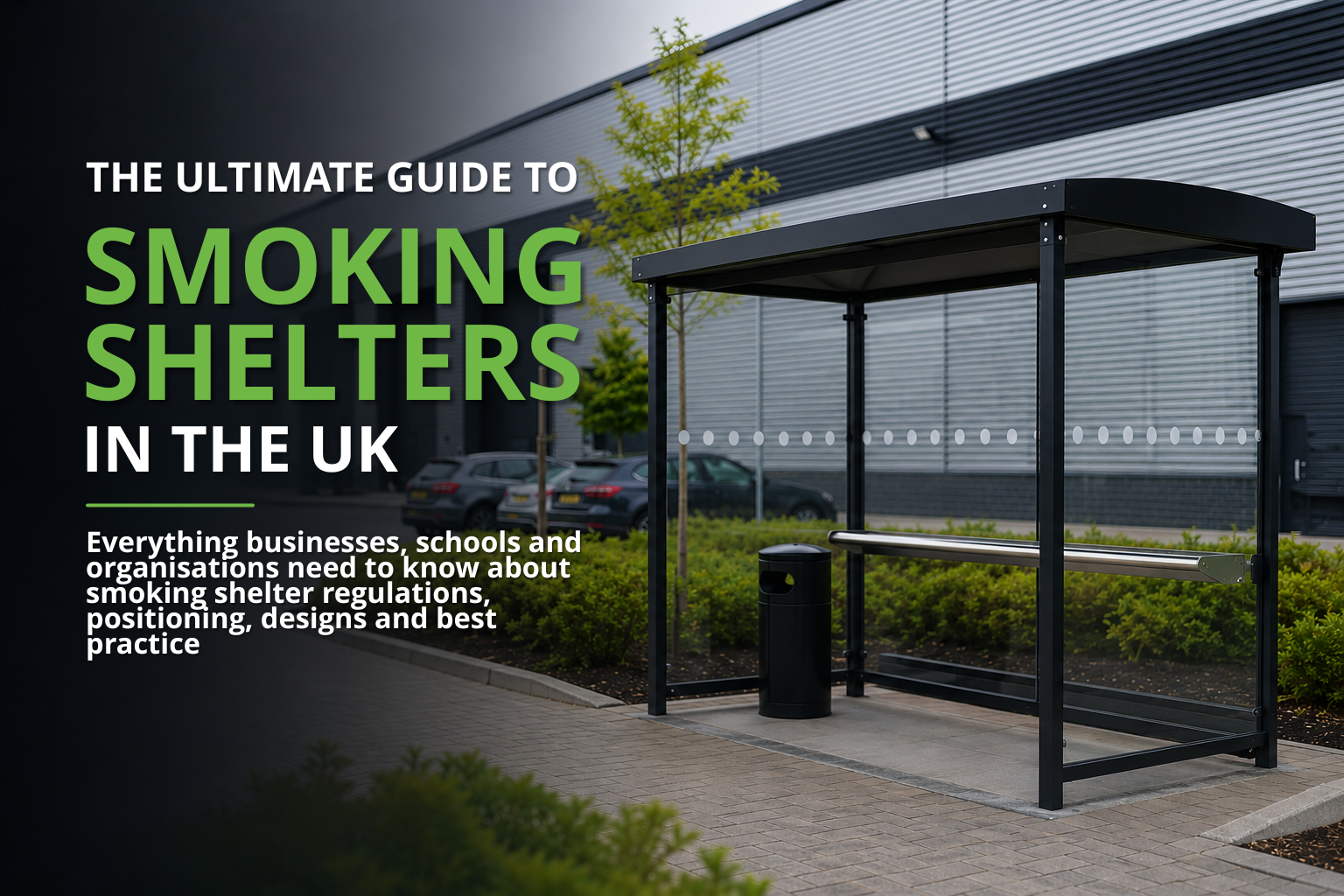
For businesses, schools, hospitals, warehouses, factories and other organisations, managing smoking on site can be more complicated than simply deciding where employees and visitors should stand.
A well-planned outdoor smoking shelter can help create a clearly designated smoking area, keep smokers away from entrances and busy pedestrian routes, reduce cigarette litter and provide protection from the British weather. However, the design and positioning of a smoking shelter also need careful consideration.
This ultimate guide to smoking shelters in the UK explains what smoking shelters are, the rules surrounding them, where they should be positioned, the different designs available and what organisations should consider before buying one.
What Is a Smoking Shelter?
A smoking shelter is an outdoor structure designed to provide a designated place where people can smoke while receiving some protection from rain, wind and other weather conditions.
They are commonly installed at:
- Offices and business parks
- Factories and manufacturing facilities
- Warehouses and distribution centres
- Hospitals and healthcare facilities
- Universities and colleges
- Retail and commercial sites
- Construction and industrial sites
- Hospitality premises
- Local authority facilities
Smoking shelters are available in various sizes and configurations, including freestanding smoking shelters, wall-mounted smoking shelters and smoking canopies.
The important distinction is that a smoking shelter must remain sufficiently open rather than becoming an enclosed or substantially enclosed space.
What Are the UK Smoking Shelter Regulations?
This is one of the most important considerations when planning a smoking area.
Smoke-free legislation introduced across the UK prohibits smoking in enclosed workplaces and public buildings. In England, the relevant legislation includes the Health Act 2006 and the Smoke-free (Premises and Enforcement) Regulations 2006.
For a roofed structure in England, the regulations define premises as “substantially enclosed” where the openings in its walls amount to less than half the total area of the walls, including other structures that serve the purpose of walls.
This is where the commonly used 50% smoking shelter rule comes from.
In practical terms, simply calling something an “outdoor shelter” does not automatically make it suitable for smoking. Its roof, walls, openings and nearby structures all need to be considered.
Organisations should therefore choose a smoking shelter specifically designed with smoke-free legislation in mind rather than attempting to convert a conventional enclosed shelter.
Rules differ between England, Wales, Scotland and Northern Ireland, so organisations operating across the UK should check the requirements applicable to the installation location.
Has UK Smoking Law Changed in 2026?
This is particularly important for organisations planning new smoking areas.
The Tobacco and Vapes Act 2026 gives the Government powers to strengthen smoke-free protections in certain outdoor places. In England, the Government consulted in 2026 on proposals that would make outdoor areas of most education settings, including schools, smoke-free.
At the time of writing, these proposed restrictions should not be confused with the rules currently in force. Organisations, particularly schools and other education settings, should check the latest Government guidance before installing or relocating a smoking shelter.
The existence of these new powers does not mean that every outdoor workplace smoking shelter has suddenly become unlawful. However, it does reinforce the importance of checking current requirements rather than relying on guidance written several years ago.
Does an Employer Have to Provide a Smoking Shelter?
Generally, employers are not legally required to provide employees with a smoking shelter.
However, there can be practical reasons for providing a designated outdoor smoking area.
Without one, smokers may naturally gather beside entrances, loading bays, fire exits or other covered areas. That can create problems involving second-hand smoke, cigarette litter, appearance and site management.
A properly positioned workplace smoking shelter gives organisations greater control over where smoking takes place.
It can also make expectations clearer for staff, contractors and visitors.
Where Should a Smoking Shelter Be Positioned?
Choosing the shelter itself is only half the job. Location is equally important.
Where possible, a designated smoking area should be positioned away from:
- Main entrances and exits
- Opening windows
- Air-conditioning intakes and ventilation systems
- Busy pedestrian routes
- Emergency exits
- Vehicle movements
- Combustible materials
- Fuel or chemical storage
- Areas heavily used by non-smokers
Accessibility and security should also be considered.
For industrial sites, factories and warehouses, the smoking shelter may need to fit within existing traffic-management arrangements. On sites operating during early mornings, evenings or night shifts, suitable lighting and a safe walking route may also be important.
The goal should be to create a safe, practical and clearly designated smoking area without creating inconvenience or unnecessary smoke exposure elsewhere on the site.
Freestanding vs Wall-Mounted Smoking Shelters
There is no single smoking shelter suitable for every site.
A freestanding smoking shelter can be positioned independently of the main building, giving organisations greater flexibility over location.
These shelters are particularly useful for larger commercial premises, warehouses, factories, hospitals and business parks where the smoking area needs to be moved away from entrances.
A wall-mounted smoking shelter or smoking canopy can be a practical solution where outdoor space is limited.
Because the shelter interacts with an existing building, however, the surrounding walls and structures need to be taken into account when assessing whether the area remains compliant with smoke-free requirements.
Larger and Bespoke Smoking Shelters
Sites with larger workforces may require greater capacity or a bespoke configuration.
Before choosing a shelter, consider how many people are likely to use it simultaneously, particularly during scheduled breaks and shift changes.
Buying a shelter that is too small can result in people standing around the outside of it, defeating much of the purpose of creating a controlled smoking area.
What Materials Should You Look For?
Commercial smoking shelters spend their entire lives outdoors, so material quality matters.
Tamstar smoking shelters typically use heavy-duty galvanised steel frames, with optional polyester powder coating available on suitable models.
Galvanising helps protect steel against corrosion, while powder coating can provide additional protection as well as allowing the structure to complement company or site colours.
Glazing is another important consideration. Tamstar shelters use impact-resistant transparent glazing on applicable designs, helping provide weather protection without creating a visually enclosed environment.
When comparing smoking shelters, consider:
- Frame construction
- Corrosion resistance
- Glazing material
- UV resistance
- Ground-fixing method
- Replacement-part availability
- Maintenance requirements
- Expected site conditions
The cheapest shelter is not necessarily the lowest-cost solution over its working life.
What Accessories Does a Smoking Area Need?
A well-designed smoking area is more than the shelter itself.
One of the most useful additions is a dedicated cigarette bin or ashtray. Providing an obvious disposal point can help prevent cigarette ends from accumulating around entrances, paths and landscaped areas.
Other useful smoking shelter accessories include:
- Wall-mounted ashtrays
- Freestanding cigarette bins
- Litter bins
- Smoking-area signs
- Benches or seating
- Replacement glazing panels
Tamstar supplies smoking shelter accessories including cigarette disposal products, signage and recycled plastic seating, allowing organisations to create a more complete designated smoking area.
Do Smoking Shelters Need Planning Permission?
Planning requirements depend on the individual project.
Factors such as the shelter’s dimensions, location, property type, land use, local planning policies and any restrictions affecting the site can all influence whether consent is required.
Businesses should therefore not assume that every smoking shelter is automatically exempt from planning permission.
For larger shelters, prominent installations, listed buildings, conservation areas or sites with particular planning restrictions, checking with the relevant local planning authority before installation can prevent problems later.
Landlords or managing agents may also require approval on leased premises.
What Surface Does a Smoking Shelter Need?
A shelter needs a suitable base and fixing arrangement.
Many commercial shelters are designed for installation onto a solid concrete surface using base plates and appropriate ground fixings.
Before installation, check:
- The surface is suitable for the proposed fixing method
- The base is level
- Underground services have been identified
- Drainage is adequate
- There is sufficient clearance around the shelter
- Installation will not obstruct access routes
Good groundwork can make a significant difference to the stability and long-term performance of an outdoor shelter.
Should Smoking and Vaping Use the Same Shelter?
Under current general UK workplace rules, e-cigarettes are not treated identically to conventional smoking. GOV.UK states that the workplace smoking law does not itself apply to e-cigarettes, meaning employers can establish their own policies regarding vaping on their premises.
Some organisations nevertheless choose to create a combined smoking and vaping shelter because it gives employees and visitors a clearly identified location and simplifies site management.
Others prefer separate areas.
Your approach should reflect company policy and the latest regulations applicable to your premises, particularly as the Tobacco and Vapes Act 2026 provides powers for further vape-free restrictions.
How Do You Maintain a Smoking Shelter?
A commercial outdoor shelter should be inspected periodically rather than simply installed and forgotten.
A sensible maintenance programme can include:
- Checking bolts and ground fixings
- Inspecting glazing for cracks or damage
- Checking steelwork for signs of corrosion or coating damage
- Cleaning transparent panels
- Emptying cigarette bins regularly
- Removing cigarette litter
- Checking signs remain visible
- Inspecting benches and other accessories
- Ensuring the surrounding surface remains safe
Individual components can often be repaired or replaced rather than replacing the complete shelter.
This can extend the service life of the structure and reduce long-term costs.
Common Mistakes When Buying a Smoking Shelter
Several problems can be avoided with better planning.
Choosing on price alone: A low initial price means little if the structure is unsuitable for intensive commercial use.
Ignoring the 50% rule: Adding extra side panels later could potentially change whether a roofed area is considered substantially enclosed.
Installing it too close to an entrance: This can expose employees, visitors and customers to smoke as they enter the building.
Buying too small: Think about peak usage rather than simply the total number of smokers employed.
Forgetting cigarette disposal: Without appropriate ashtrays or cigarette bins, litter can quickly become a problem.
Ignoring the base: Even a high-quality shelter needs an appropriate foundation and secure fixing.
Forgetting future maintenance: Check whether replacement glazing and other components can be sourced.
How to Choose the Right Smoking Shelter
Before ordering, ask these questions:
- How many people will use the shelter at peak times?
- Where can it be positioned away from entrances and busy areas?
- Does its design meet the applicable smoke-free requirements?
- Is a freestanding or wall-mounted shelter more appropriate?
- What surface will it be installed onto?
- Is planning permission or landlord approval required?
- Do we need seating?
- Do we need a cigarette bin or ashtray?
- Will the shelter require professional installation?
- Can replacement components be obtained in future?
Answering these questions before purchasing can prevent expensive changes later.
Why Choose Tamstar for Smoking Shelters?
Tamstar Ltd supplies a wide range of smoking shelters throughout the UK, from compact wall-mounted options to freestanding commercial shelters and larger solutions.
Our range is designed for organisations including offices, warehouses, manufacturing facilities, councils, colleges, universities, healthcare sites and commercial premises.
Depending on the product and project, Tamstar can provide features including galvanised steel construction, impact-resistant glazing, optional powder-coated finishes, cigarette bins, ashtrays, seating and smoking-area signage.
We can also help organisations looking for a more complete outdoor facilities solution, including cycle storage, recycled plastic furniture and bespoke outdoor shelters.
Frequently Asked Questions About Smoking Shelters
What is the 50% rule for smoking shelters?
For roofed structures in England, the Smoke-free Regulations provide that premises are substantially enclosed where openings in the walls total less than half of the wall area. This is commonly referred to as the 50% rule. Surrounding structures can form part of the calculation, so each installation needs to be considered carefully.
Is a smoking shelter compulsory at work?
No. Employers generally do not have to provide employees with a smoking shelter. Many businesses provide one voluntarily to better manage smoking locations and cigarette litter.
Can a smoking shelter have a roof?
Yes. A compliant outdoor smoking shelter can have a roof, provided the overall structure does not become enclosed or substantially enclosed under the applicable legislation.
Can you smoke in a three-sided shelter?
Potentially, but the number of sides alone does not determine compliance. The dimensions of openings and surrounding structures need to be considered. A three-sided structure should therefore not automatically be assumed to comply.
Can employees vape in a smoking shelter?
An employer can establish its own workplace vaping policy under current general workplace rules. Many organisations choose to direct vaping to the same designated outdoor area, although new vape-free powers introduced under the Tobacco and Vapes Act 2026 mean organisations should keep policies under review.
Where should a workplace smoking shelter be located?
Ideally, away from building entrances, opening windows, ventilation intakes, busy pedestrian routes and other areas where smoke could affect non-smokers. Site-specific fire, access and traffic risks should also be considered.
Do smoking shelters need to be fixed down?
Commercial shelters normally require secure fixing to an appropriate base. Always follow the manufacturer’s installation requirements for the particular shelter.
Can an old smoking shelter be refurbished?
Often, yes. Depending on its condition, damaged glazing, coatings, fixings and accessories may be replaceable, potentially extending the useful life of the shelter.
Final Thoughts
A smoking shelter is not simply a roof and a few panels. For a commercial organisation, it forms part of wider facilities management, site safety, cleanliness and workplace planning.
The right shelter should provide useful weather protection while remaining appropriately open, be positioned away from areas used by non-smokers, provide adequate capacity and be built from materials capable of coping with long-term outdoor use.
With legislation continuing to develop, particularly following the Tobacco and Vapes Act 2026, organisations should also review their smoking and vaping arrangements periodically rather than assuming that an installation will always remain suitable.
Tamstar Ltd supplies commercial smoking shelters, smoking and vaping shelters, wall-mounted smoking shelters and smoking shelter accessories across the UK, together with installation options and advice for organisations planning new or replacement outdoor facilities.
Whether you are creating a new designated smoking area or replacing an ageing shelter, careful planning at the start can result in a cleaner, safer and better-managed outdoor space for years to come.