Whether you manage a school, workplace, office, university, hospital, retail site or public building, providing somewhere safe and practical for people to leave their bicycles is becoming an increasingly important part of managing outdoor facilities.
A well-designed bike shelter does much more than keep bicycles out of the rain. It can help protect bikes, organise cycle parking, make better use of outdoor space and encourage employees, pupils and visitors to choose cycling as part of their everyday journeys.
With active travel continuing to receive significant attention across the UK, organisations are also reviewing whether their existing cycle storage is suitable for current and future demand.
This guide explains what to consider when choosing a bike shelter in the UK, including shelter size, cycle capacity, security, materials, location, installation, planning considerations and the different types of cycle parking available.
What Is a Bike Shelter?
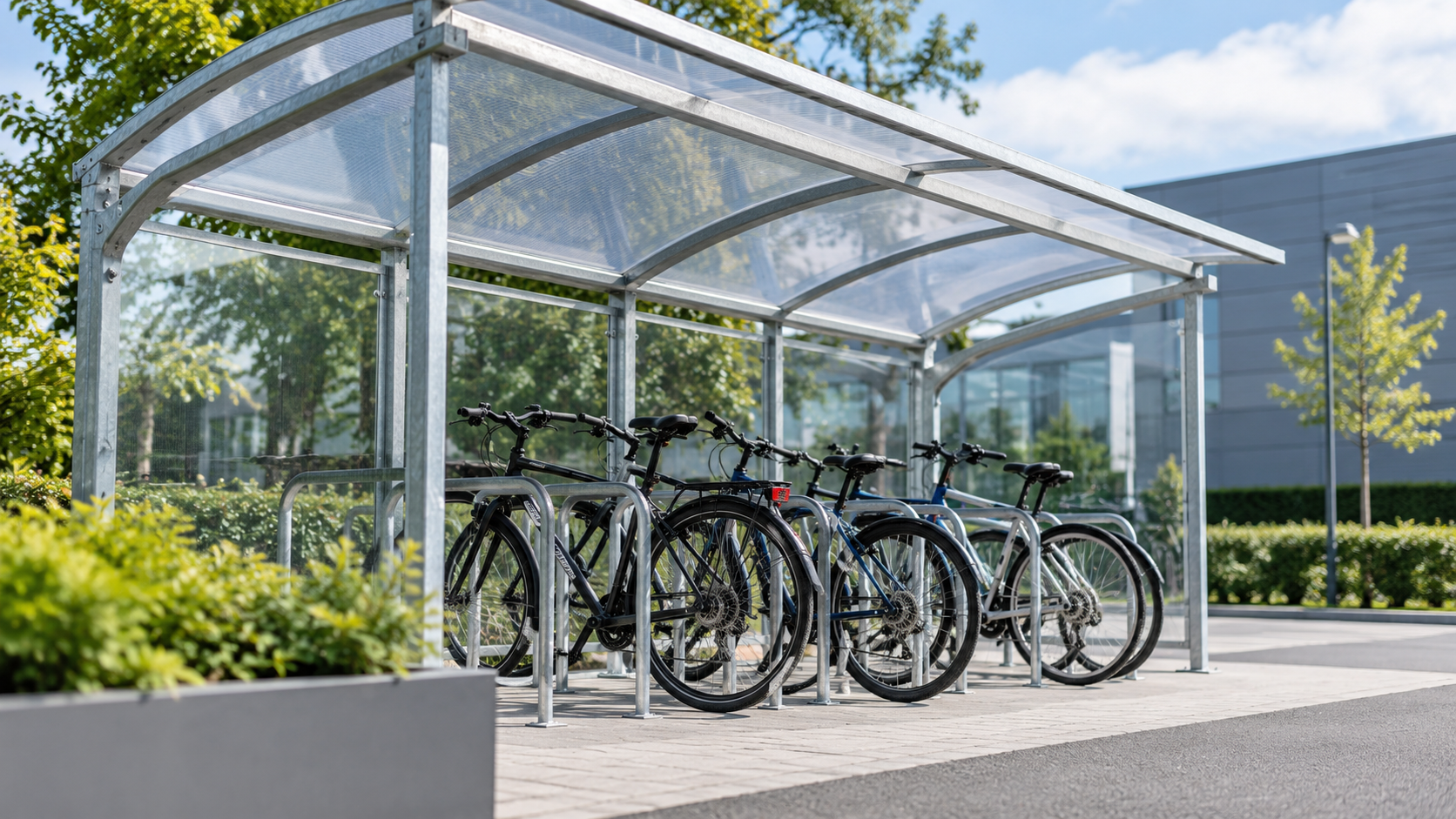
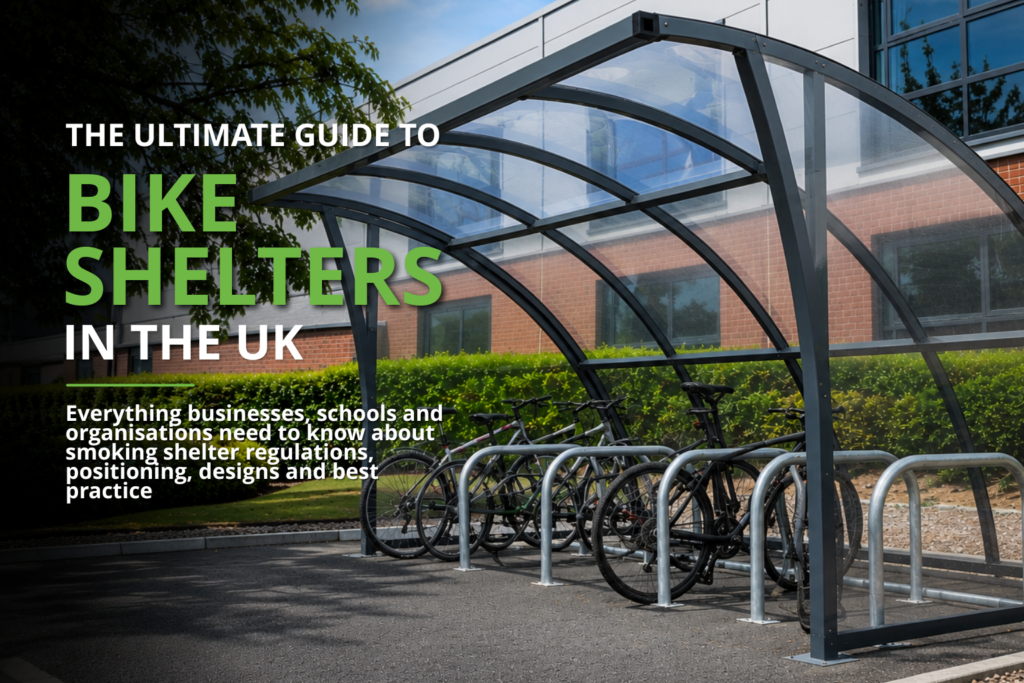
A bike shelter, sometimes called a cycle shelter, is a covered structure designed to provide designated parking and weather protection for bicycles.
Depending on the design, a shelter may incorporate:
- Sheffield cycle stands
- Toast racks
- Individual cycle hoops
- Cycle racks
- Side and rear panels
- Security compounds or gates
- Powder-coated or galvanised steel frames
- Polycarbonate glazing
The right solution depends on the number of bicycles being stored, the type of site, available space and the level of security required.
At Tamstar, our range of bike sheds and cycle storage solutions includes options for schools, businesses and organisations requiring anything from compact cycle parking to larger-capacity installations.
Why Are Bike Shelters Important?
One of the biggest barriers to cycling can be uncertainty about where a bicycle can be left safely at the destination.
The Department for Transport’s Cycle Infrastructure Design guidance, LTN 1/20, specifically covers cycle parking as part of the infrastructure required to support cycling.
Providing appropriate cycle storage can therefore support a wider active-travel strategy.
For organisations, the potential benefits include:
Weather protection: A covered bike shelter helps protect bicycles from rain and other weather conditions while they are parked.
Improved organisation: Dedicated cycle parking prevents bicycles being left against buildings, fences, railings, entrances or pedestrian routes.
Security: Properly positioned cycle stands allow users to secure their bicycles more effectively than informal parking.
Encouraging active travel: Convenient cycle parking can make cycling to work, school or other destinations more practical.
Better use of outdoor space: A carefully planned shelter creates a defined parking area without requiring a large amount of land.
Supporting sustainability objectives: Encouraging cycling can form part of an organisation’s wider environmental, ESG or sustainable travel strategy.
Current government policy continues to support investment in walking, wheeling and cycling. In June 2026, the Department for Transport and Active Travel England published an evidence review examining investment in walking, wheeling and cycling schemes and programmes in England.
What Types of Bike Shelter Are Available?
There is no single cycle shelter suitable for every site.
Small Bike Shelters
A smaller 6-cycle bike shelter can be ideal where space or expected demand is limited.
These can suit smaller offices, primary schools, shops, community facilities and sites introducing cycle parking for the first time.
Tamstar’s range, for example, includes the Spectrum 6 Cycle Toast Rack Shelter, providing a compact option for designated cycle storage.
10-Cycle Bike Shelters
For many workplaces and schools, a 10-bike shelter provides a useful balance between capacity and footprint.
Tamstar’s Astro 10 Cycle Bike Shelter is one example within our cycle shelter range.
Large-Capacity Cycle Shelters
Schools, universities, offices and larger commercial sites may need considerably greater capacity.
Systems such as Tamstar’s Atria 20 Cycle and Sigma 20–40 Cycle shelters provide options for organisations expecting higher levels of cycle use.
When planning a larger installation, think beyond today’s demand. Installing a shelter that is already full shortly after completion may mean additional expenditure later.
Bike Shelters for Schools
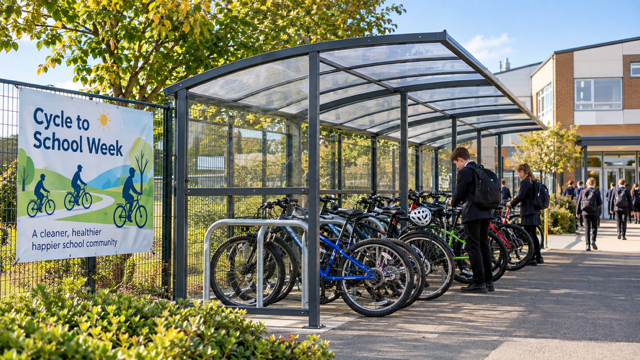
Schools are one of the most obvious locations for dedicated school bike sheds.
Good cycle parking can help make cycling to school a more realistic option while keeping bicycles organised away from entrances, playgrounds and vehicle routes.
Transport for London’s school guidance notes that installing cycle parking can encourage pupils and colleagues to cycle, potentially supporting exercise, reducing congestion and improving conditions around school gates.
Location is particularly important.
School cycle shelters should normally be:
- Easy for pupils to reach
- Clearly visible
- Away from moving vehicles
- Conveniently located
- Large enough for expected demand
- Positioned where there is appropriate natural surveillance
Department for Education estate guidance also stresses that pedestrians and vehicles should be able to circulate safely and that parking and playground areas should be appropriately separated.
Schools planning new facilities should also check the latest Department for Education design guidance and their local planning requirements. Updated school and college design and construction guidance was published during 2026.
Bike Shelters for Workplaces
A workplace bike shed can form an important part of an organisation’s employee facilities.
If staff are being encouraged to cycle to work but arrive to find no secure or weather-protected parking, uptake may be limited.
HSE workplace transport guidance recommends providing parking areas for vehicles including pedal cycles where possible and locating parking in safe and suitable places.
Businesses planning their cycle facilities should consider:
- Number of employees
- Existing cycle usage
- Expected future demand
- Shelter location
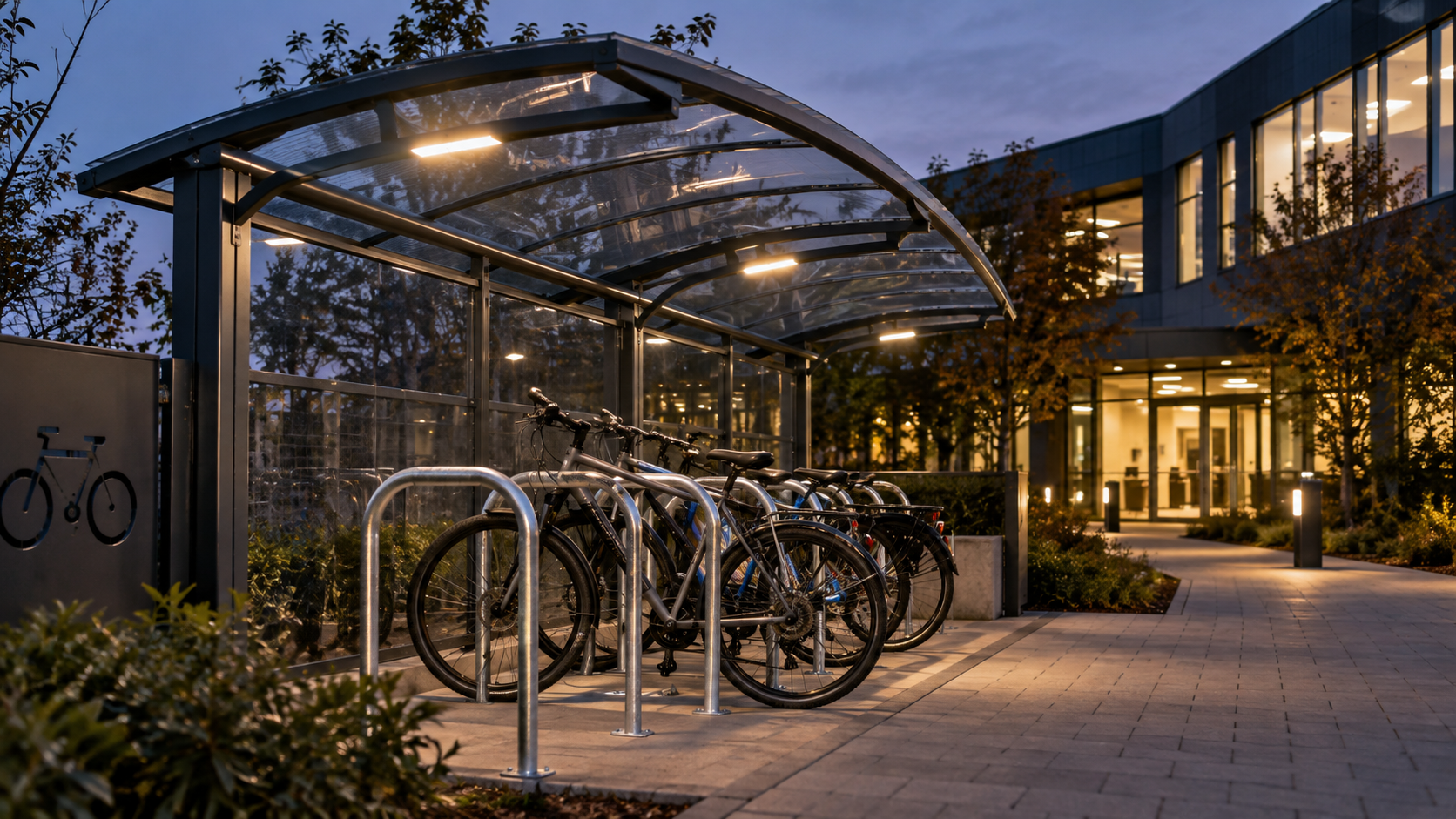
- Lighting
- CCTV or natural surveillance
- Access control where appropriate
- Changing facilities and lockers
- Safe routes between the shelter and building entrance
Some local planning policies go further. For example, current Wakefield design guidance calls for employment developments to incorporate secure, covered cycle parking in prominent locations and also refers to showers, changing rooms, drying areas and lockers.
Requirements vary geographically, so local planning policy should always be checked.
What Makes Good Cycle Parking?
A shelter is only part of the solution. The bicycles also need something suitable to lock onto.
Sheffield stands remain a popular choice because they can support the bicycle and provide points for locking the frame and wheels.
Toast racks combine multiple cycle parking positions into a single unit, making them useful where a straightforward, high-capacity arrangement is required.
Whatever system is selected, users should have sufficient room to manoeuvre their bicycles comfortably without creating unnecessary conflicts between neighbouring cycles.
Good cycle parking should generally be:
Convenient. If the shelter is too far from the destination, people may park somewhere else.
Accessible. Cyclists should be able to reach it without navigating unnecessary obstacles.
Visible. Natural surveillance can improve confidence and discourage misuse.
Secure. Users should have suitable fixed points to which bicycles can be locked.
Covered. Long-stay cycle parking particularly benefits from weather protection.
Easy to use. A technically high-capacity rack is of little value if bicycles cannot be comfortably parked and removed.
Where Should a Bike Shelter Be Positioned?
Choosing the correct location is just as important as selecting the shelter itself.
Avoid simply placing it in whatever unused corner of the site is available.
Consider:
- Distance from the building – convenient parking is more likely to be used.
- Visibility – overlooked locations may improve security.
- Pedestrian movement – the shelter should not obstruct walkways or emergency routes.
- Vehicle movements – avoid creating conflict with cars, delivery vehicles and reversing areas.
- Ground conditions – a suitable base may be required for safe fixing and installation.
- Drainage – avoid areas where standing water regularly accumulates.
- Future expansion – leave space if additional cycle parking may be required later.
Which Materials Are Best for Bike Shelters?
Outdoor shelters must withstand years of exposure to the British weather.
Steel is widely used because it provides a strong structural framework. Galvanising helps protect steel against corrosion, while polyester powder coating can provide additional protection and allow the shelter to complement existing buildings or corporate colours.
Transparent or translucent polycarbonate panels are also commonly used for roofs, sides and rear sections because they provide weather protection while maintaining visibility and natural light.
When comparing bike shelters for sale, look beyond the initial price. Consider expected lifespan, construction quality, replacement parts, maintenance and the suitability of the structure for the proposed site.
How Many Cycle Spaces Do You Need?
There is no universal number suitable for every organisation.
Cycle parking requirements can vary according to:
- Building use
- Number of employees
- Number of pupils or visitors
- Local authority planning policy
- Development size
- Existing travel patterns
- Expected future cycling demand
Local authorities can have their own minimum cycle parking standards. For example, Leicester’s 2026 cycle storage guidance contains different provision standards for uses including retail, leisure and schools.
For new developments or significant refurbishments, always check the relevant local authority requirements rather than assuming a national figure applies.
Projects targeting a BREEAM rating should also check the applicable BREEAM technical requirements. BREEAM maintains specific guidance concerning cyclist facilities and compliant cycle storage.
Do Bike Shelters Need Planning Permission?
This is an area where organisations should avoid making assumptions.
Whether planning permission is required can depend on the shelter’s size, height, location, site use, local restrictions and whether the property is in a conservation area or has other planning constraints.
Rules applying to domestic outbuildings should not automatically be assumed to apply to a commercial, educational or public-sector bike shelter.
The safest approach is to contact the relevant Local Planning Authority before installation if there is any uncertainty. The Planning Portal similarly advises contacting the local authority when there is uncertainty over whether a proposed structure requires permission.
What About Bike Shelter Security?
No outdoor cycle parking solution can guarantee that a bicycle will never be stolen, but good design can help reduce opportunities for theft.
Consider:
- Strong, securely fixed cycle stands
- Good visibility
- Appropriate lighting
- CCTV where suitable
- Positioning close to occupied buildings
- Controlled access for higher-security installations
- Secure compounds for valuable bicycles or long-term storage
Security should be considered at the design stage rather than added as an afterthought.
As e-bikes become more common and bicycles themselves become more valuable, organisations may also want to review their wider policies covering access, charging and storage.
How Much Does a Bike Shelter Cost?
The cost of a bike shelter depends on several factors, including:
- Cycle capacity
- Overall dimensions
- Frame construction
- Galvanised or powder-coated finish
- Type of cycle rack
- Glazing
- Groundworks
- Installation
- Security requirements
- Bespoke modifications
The cheapest shelter is not necessarily the most cost-effective over its working life.
For facilities managers and schools working within fixed budgets, it is better to compare whole-life value, durability and suitability rather than purchase price alone.
Bike Shelter Maintenance
Cycle shelters are generally relatively low-maintenance, but they should still be inspected periodically.
A sensible maintenance programme should check:
- Frame condition
- Corrosion or coating damage
- Loose fixings
- Damaged glazing
- Cycle rack fixings
- Roof condition
- Drainage around the shelter
- Ground surface
- Lighting and security equipment
Early repairs can prevent minor damage developing into a larger and more expensive problem.
Choosing the Right Bike Shelter: Final Checklist
Before ordering a cycle shelter, ask:
- How many bikes must it accommodate?
- Could demand increase?
- Who will use it?
- Is the location convenient?
- Is the location safe and visible?
- What level of weather protection is required?
- Which cycle stands or racks are most suitable?
- Is enhanced security required?
- Is the ground suitable for installation?
- Are there local planning requirements?
- Are there accessibility or pedestrian-route considerations?
- Could the shelter need extending later?
- Who will inspect and maintain it?
Answering these questions before purchasing can prevent expensive mistakes.
Find the Right Bike Shelter for Your Site
A well-planned bike shelter is more than somewhere to park bicycles. It is part of creating a practical, organised and cycle-friendly site.
Whether you need a school bike shelter, workplace cycle shelter, commercial bike storage solution, Sheffield stands or a larger-capacity cycle storage system, the key is matching the shelter to the people who will actually use it.
Tamstar Ltd supplies a range of bike shelters and cycle storage solutions across the UK, including smaller cycle shelters and larger-capacity systems for schools, workplaces and other organisations.
Explore Tamstar’s bike shelters and cycle storage range or contact the team for help identifying the most suitable solution for your site.